Both variants of work have their advantages and disadvantages. Considering that I have experience of a freelancer, I can tell the differences between working freelance and a regular office job based on my experience.
Advantages of Freelancing
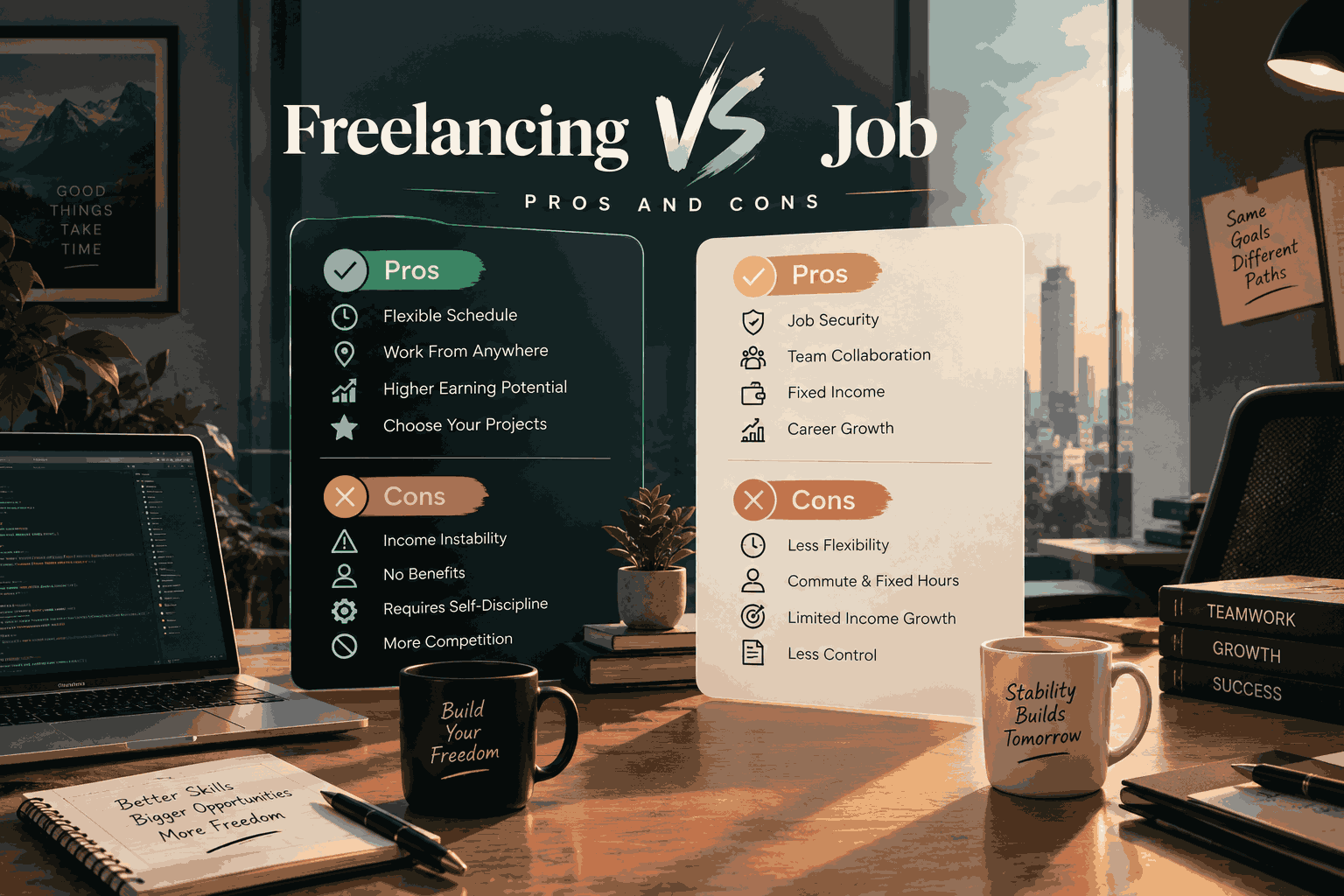
1. Multiple skills, not a specific role. While in a specific position, you have to keep doing the same thing, but being a freelancer allows you to invest your time and energy into acquiring new skills.
2. No limits to the income the more clients and the more time you invest, the more money you can earn.
3. Work schedule flexibility work schedule is personalized based on your activity.
4. Learning with each client while you work on different projects with a variety of clients, you have to learn their requirements.
5. Easier growth being not tied to a specific position, allows you to grow faster in the development field.
Disadvantages of Freelancing
1. Need to invest time you can not earn money right away, at the beginning of your freelance way, and this is frustrating;
2. No guarantees while working for an employer, you have a guaranteed income;
3. Higher competition in 2026 to find a client, you have to compete with others;
4. Requires research , unlike a regular job, working as a freelancer requires preliminary research on the market;
5. Unpredictable clients, some clients may be challenging to work with.
Advantages of a Job
1. Predictable income – having a steady job with a decent wage is rewarding;
2. Financial stability – having a guaranteed income may help to cover expenses without stress;
3. Clear structure – knowing how and when you need to work makes everything clear and removes guesswork;
4 .Extra benefits – most employers provide additional benefits such as medical care;
5. Easier to get started – unlike a freelancer, you do not have to seek clients; you can start working immediately.
Disadvantages of a Job
1. Can be a hamper – a stable but routine job can cripple you over time;
2 . No skill diversification – you can only hone your skills in one area;
3. No wage growth – you only get a small increase in wages;
4. Comfort zone – job stability can prevent from developing further skills;
5. Control – everything is planned for you so you can have fewer opportunities to choose what and how to do.
Conclusion
Both variants of work have their advantages and disadvantages. Working as a freelancer provides multiple skills and faster improvement but requires more effort, especially at the beginning, while a regular job keeps you at the same level at least. Having said that, in 2026, it has become more difficult to sustain oneself as a freelancer because of the high competitiveness of the job market. To succeed in freelancing, you need to invest time and effort and do preliminary research, but then, if you are not satisfied with the results, you can return to a regular job. Thus, a regular job, while providing a steady income, can be more stressful and less flexible in comparison to freelancing.