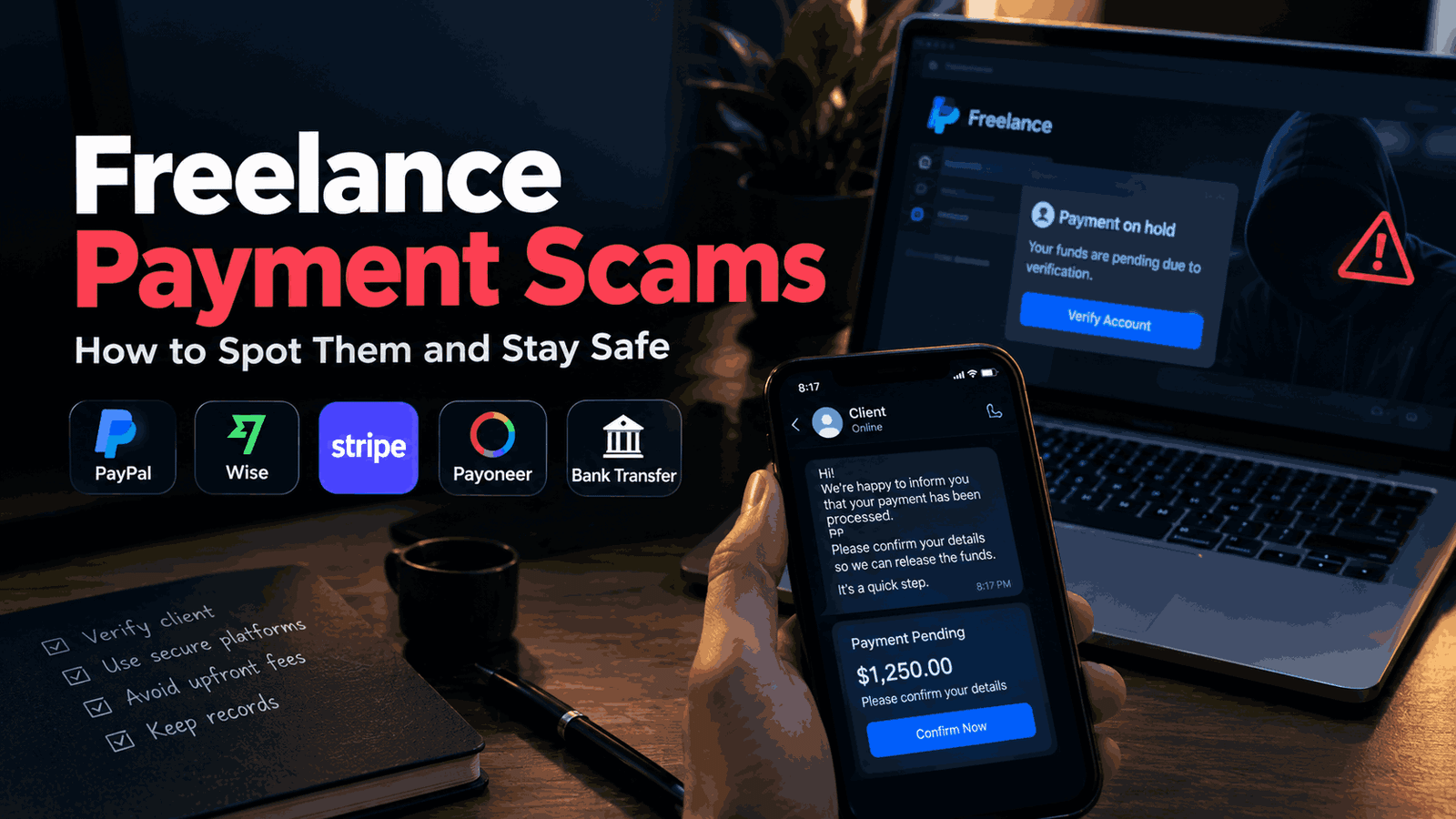
How to Avoid Freelance Payment Scams and Get Paid on Time
As a freelancer doing the work is the part of freelancing. Getting paid for it is where many new freelancers get hurt. Some clients vanish after you deliver some of them keep upping the excuses for months and some offer the proof for payment. Working as a freelancer for more than three years I’ve encountered most of such problems In this guide I will tell you how to protect yourself and get paid without any issues.
Why Payment Problems Exist in Freelancing
Since you work online you meet clients that you have never seen, there’s no office, no manager and no company to approach if something goes wrong which makes some people to take advantage of the freelancers (new ones who are eager to catch their first projects and do not want to ask a bunch of questions).
It doesn’t mean every client is a scammer, some are really innocent but messy, disorganized and vague. The aim is not to fear every client but to create a system that protects you with everyone.
Take Some Payment Upfront
This is the most important lesson I learned. Always take something upfront from your new clients.
In my experience when I didn’t take payment in advance some clients kept me waiting for two or three months, always having a reason and a story, but finally, I had to invest my own time (which was of no value to them) to get my money back. Advance changes it altogether, it tells the client that he is serious and protects your time in case he decides not to pay. If the client refuses to pay anything and has no history on a freelance platform, take it as a hint.
A simple way to do it:
‣Ask for 30-50% before starting
‣Take the rest on delivering
‣And for the projects, split the payment into milestones.
‣Ask for Some Security
Besides the advance, ask the client to provide you with some kind of security. It doesn’t have to be complicated, it simply means to provide you with certain security in case something goes wrong.
You can do this by:
‣‣Working through a platform that securely holds the payment (Fiverr, Upwork etc)
‣‣Using milestone payments so you never work long without being paid
‣‣Previewing the work (watermarked version) first and then delivering the final file after getting the payment.
‣‣Keeping the final files until the payment is confirmed.
As a video editor, I find the preview method really effective. The client sees the quality (he/she cannot use the final video until he/she pays). Choose a Safe Payment Method.The way a client pays you matters as much as the amount. Always ask them to use a reliable traceable method. Avoid working with clients who:
‣Want to move the conversation/payment out of the platform
‣Ask you to use an unusual, untraceable method
‣Ask you to pay a fee before they can give you yours.
‣Send you a cheque/payment for more than the amount you asked for and ask you to refund the rest.
This last one is the classic scam. The original payment gets reversed (gets canceled) and you lose the money you sent to them. Never refund money to anyone until the original payment has cleared (appeared in your account). Always Ask for a Payment Screenshot But Verify It
Safe Side
When a client says he made the payment, it is a habit to ask for a screenshot. It gives you a record that the client takes this seriously. But a screenshot doesn’t guarantee that the payment went through. Some scammers use fake screenshots to fool freelancers into sending them files. The real proof of payment is the money showing up in your account.
So do this:
‣Ask for the screenshot as a record
‣Check your account/app by yourself to see whether the money is there
‣Release the final files only when the money is there.
‣Remember that the money sometimes show up as pending for some time so you have to wait until the payment is clearly shown as arrived.
‣Communicate Clearly About Payment
‣Most payment problems are a result of communication issues, not of malice. Discuss money at the beginning not at the end.
Know the Red Flags of a Client
‣Learn what red flags are to know whether a client is worth working with or not. These are the ones I look at:
‣Client who is vague about the price and payment terms.
‣Someone who offers a very high pay for almost nothing.
‣A client who refuses to use a secure platform/payment method.
‣Asks to do test work (for free) with no limitations.
‣Pushes you to start the work without talking about the payment.
‣New account with no reviews/history.
‣Stories that keep changing.
‣One red flag doesn’t always mean a scam, but several usually point to one. Trust your instincts, if something feels wrong, it probably is.
How to Follow Up When a Client Delays Payment
Good clients sometimes forget to pay. Here is what to do to make sure you get paid without destroying the relationship.
‣Send a reminder on the due date (with the invoice attached)‣
‣Follow up again (still politely) after a few days.
‣Pause the work until the pending payment is cleared.
‣Do not send the final files until the payment is cleared.
‣Escalate (use the platform’s system to report or complain) it if necessary (if you’ve worked with them using a platform’s system).
‣Patience and persistence is the key here. You are not begging, you are requesting what was agreed upon.
Learn from Every Experience
Every freelancer has faced at least one bad experience with payment, which usually teaches them a lesson. The lesson has to be implemented so that the same mistake isn’t repeated. My lesson was quite straightforward: Never work with clients without some kind of security.Do not let one client change your whole outlook of the business. Most clients are honest and those are the ones who value you. In fact, professional clients usually feel more comfortable working with you if you’ve got a system.
Final Thoughts
Avoiding payment scams is not a matter of luck, but of a solid system: take some payment upfront, ask for some kind of security, use reliable methods, discuss money openly, verify every payment and know the red flags. Use them consistently and you will protect your time/money and your peace of mind.
Fact:
Your skill is valuable so treat your freelance work like a business and clients will treat it the same way. !